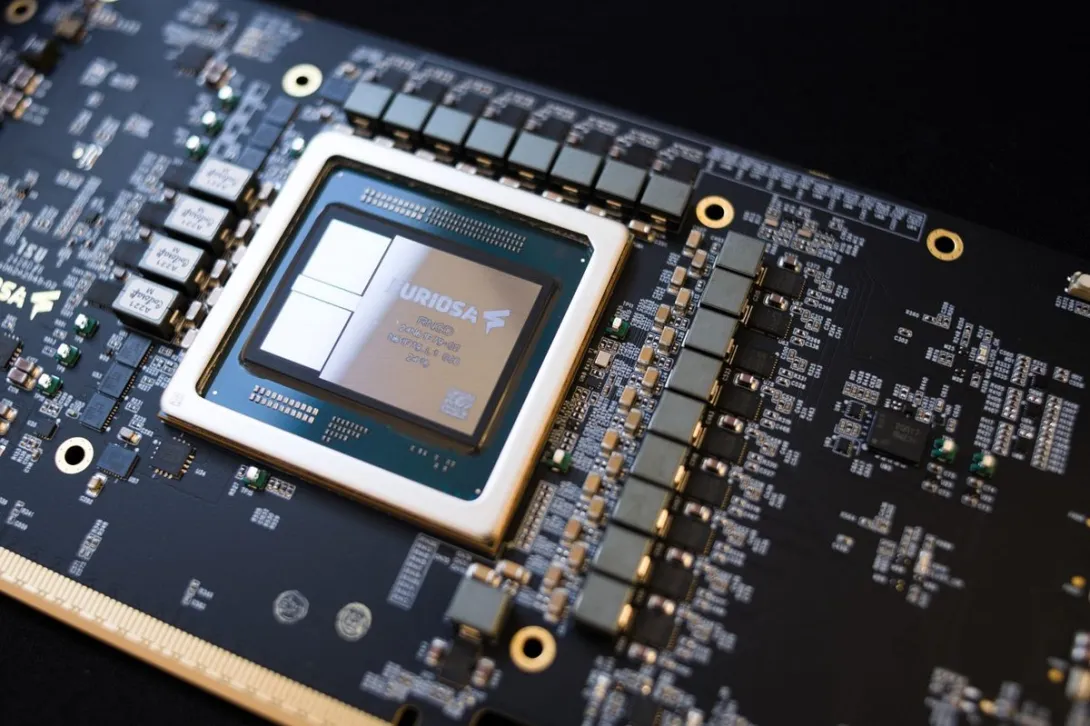
South Korean AI chip startup FuriosaAI announced on Thursday that it has closed a 620 million dollar Series D round at a post-money valuation of about 2.9 billion dollars, one of the largest financings yet for an AI semiconductor company outside the United States. The round, worth 820 billion won, roughly quadruples the valuation of about 735 million dollars reported for its previous financing, and it lands as the company's second-generation inference accelerator moves from launch into volume production.
The money is a mix of state backing and global private capital. South Korea's National Growth Fund was the largest single investor, committing about 280 million dollars, while international investors contributed 110 million dollars. That group includes Infinitum, the largest international backer, alongside Jericho Capital, QUDA Capital, Cisco Investments, NeoFort Holding and Worldline Capital. Existing shareholders added 125 million dollars in follow-on funding, with Korea Development Bank contributing a further 22 million dollars, and all three of the company's original seed investors — NAVER, DSC Investment and KDB Capital — took part again. The Export-Import Bank of Korea made its first direct investment in a startup by joining the round, and UAMCO and Hanwha Asset Management joined as new domestic investors.
"This Series D financing marks an important milestone for FuriosaAI and reflects the confidence of investors around the world in our technology and ability to execute," said June Paik, the company's co-founder and chief executive. Paik, who founded the Seoul company in 2017, added that FuriosaAI is entering a new phase of bringing its technology to the global AI infrastructure market at scale, accelerating commercialization of its current chip and advancing development of its next generation.
That current chip is RNGD, an accelerator built specifically for inference — running trained models in production — rather than training them. RNGD entered mass production in January 2026, and FuriosaAI expects to produce 20,000 cards this year, with memory and fab capacity secured to more than double that output in 2027. The chip ships as a 180-watt, air-cooled PCIe card designed to fit existing racks and power budgets without a cooling retrofit. Eight cards form the company's NXT RNGD Server, a 4U system rated at 3 kilowatts, 4 petaFLOPS of FP8 compute and 384 GB of HBM3 memory. FuriosaAI says RNGD matches the throughput of Nvidia's RTX PRO 6000 at the same card count while serving twice as many users per kilowatt.
The company already points to production deployments. Samsung SDS has launched an NPU-as-a-Service offering powered by RNGD, LG Group companies are running EXAONE deployments on the chip in on-premises hybrid cloud environments, and AI startup Upstage uses RNGD to serve live search summarization for millions of users. Underpinning the hardware is FuriosaAI's Tensor Contraction Processor architecture, which makes higher-dimensional tensor contraction the basic unit of work for both the silicon and its compiler, and a software stack the company says has shipped four major SDK releases this year.
The new capital will expand RNGD production, strengthen that software ecosystem and accelerate a third-generation accelerator being developed with Broadcom and other partners. FuriosaAI says the Gen 3 design will use a 2-nanometer, multi-die process with HBM4 and HBM4E memory, aimed at frontier agentic models running in large clusters. For enterprise buyers, the bet is straightforward: as inference becomes the recurring cost of AI, chips that deliver more tokens per watt give data center operators a real alternative in a market still dominated by Nvidia.