Google has announced a long-term investment of $17 billion to build its first data center in Wyoming, a campus in Laramie County south of Cheyenne that will support the company's artificial intelligence and cloud workloads. The company is developing the project with Tallgrass Energy, Black Hills Energy, American Electric Power (AEP), and Related Digital, and it says it will pay the full cost of the electricity the campus uses, along with the infrastructure its growth requires.
The most unusual part of the plan is how the site will be powered. A centerpiece is a 702-megawatt fuel-cell development using technology from Bloom Energy, manufactured in the United States. The fuel cells convert natural gas into electricity through an electrochemical reaction rather than combustion, and Google describes the project as the largest planned commercial-scale fuel-cell development of its kind. AEP plans to invest about $4 billion in the fuel-cell plant under a 20-year power purchase agreement, with construction expected to begin in 2026 and full commercial operation targeted by the end of 2028.
Because the fuel cells still run on natural gas, the project pairs them with carbon capture and storage. Google says the system is designed to capture a large majority of the fuel-cell plant's carbon dioxide emissions, which will be transported for permanent underground storage at Tallgrass's Eastern Wyoming Sequestration Hub. The deal takes Google's total contracted carbon-capture capacity to nearly one gigawatt. Additional power will come from gas generation operated by Tallgrass and Black Hills Energy, and an engineering study is evaluating whether carbon capture can also be added to Tallgrass's combined-cycle turbines. The campus itself will use air cooling instead of evaporative cooling to limit its demand on local water supplies.
Google projects roughly 2,500 construction jobs at the project's peak and about 250 long-term operations jobs, along with hundreds of millions of dollars in new property tax revenue for Laramie County and its school district. After a community meeting attended by more than 200 local residents, the company and its partners are also establishing a Community Council to address concerns from Cheyenne and surrounding communities as the project moves forward.
The timing is notable. Google announced the campus just days after United States voters backed restrictions on data center projects in 40 of 41 local ballot measures, part of a broader backlash over the power, water, and land demands of the AI buildout. Against that backdrop, the Wyoming plan reads as an attempt to show that a hyperscale campus can arrive with its power supply, its grid costs, and its emissions handling arranged in advance rather than negotiated afterward.
Plenty remains unspecified. Google has not given an opening date or a compute capacity for the data center itself, nor a breakdown of when the $17 billion will be spent. For enterprise IT leaders watching the cloud providers race to secure power, though, the message is clear: the contest for AI capacity is now as much about fuel cells, pipelines, and carbon storage as it is about servers and chips.
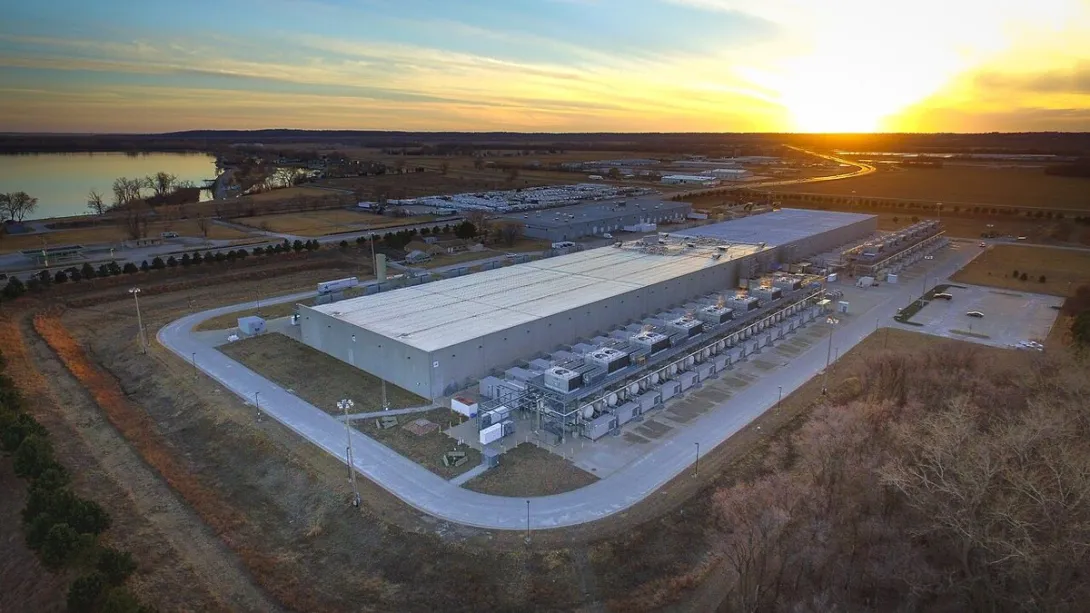
Photo: Google's existing data center in Council Bluffs, Iowa. Photograph by Chad Davis, licensed under CC BY 2.0, via Wikimedia Commons.