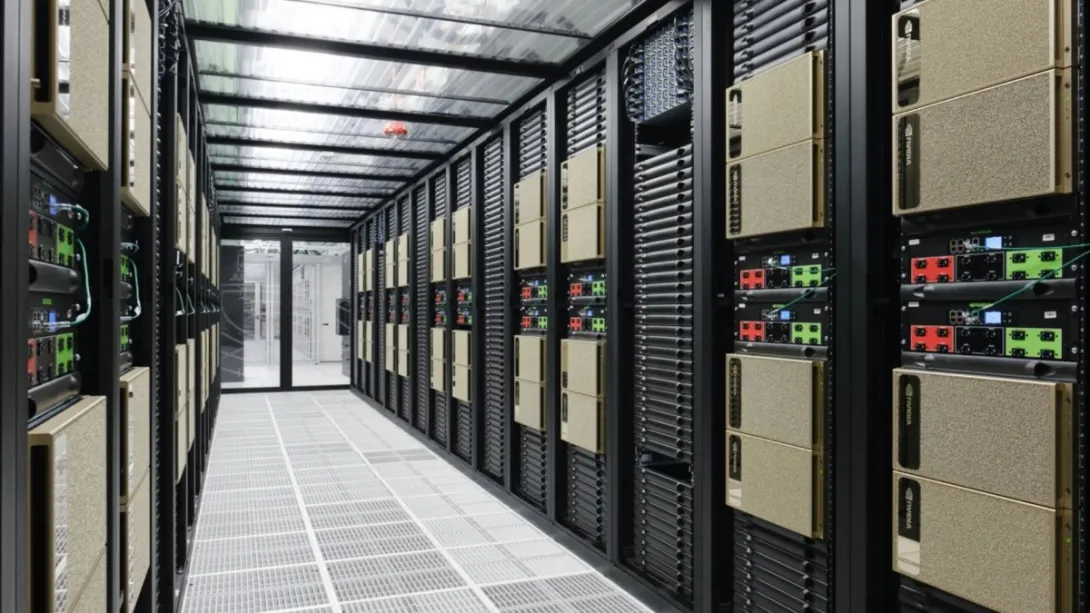
Nvidia has put a rough price on the software layer it wants to sell on top of its AI hardware: about 2,000 dollars per GPU per year for the software that runs AI agents on what the company calls AI factories. Chief executive Jensen Huang floated the figure at GTC Berlin on October 22, saying software licensing will become an increasingly major part of the company's business, with the agent software licensed, in his example, at roughly that rate per GPU annually.
The wording matters. Huang presented the number as an example — "about" 2,000 dollars — not as a published price list. Reporting by Tom's Hardware, following The Register, stresses what Nvidia has not said: which software the license would cover, how many GPUs it might apply to, whether it is a standard price, and when any such fee would take effect. It also remains unclear how the figure would sit alongside Nvidia's existing enterprise software business, and it should not be read as a confirmed price cut.
That existing business is not cheap. Nvidia's AI Enterprise platform is already listed at 4,500 dollars per GPU for a one-year subscription, more than twice the figure Huang mentioned. Nvidia has not confirmed that the two prices cover the same products or licensing terms, so enterprises cannot yet tell whether the agent software would be a new bundle, a narrower offering, or a different way of packaging tools they already pay for.
Even as an example, the arithmetic explains the strategy. One scenario outlined by FourWeekMBA assumes five million paid licenses: at 2,000 dollars per GPU per year, that would be 10 billion dollars in annual revenue, and 50 billion dollars over five years if customers kept renewing. The scenario is hypothetical, not a forecast, but it shows why recurring software revenue is attractive to a company whose hardware sales arrive in large, cyclical orders. Every GPU already deployed becomes a potential subscription, renewed long after the original purchase.
The pricing comments landed alongside a concrete product push. On October 21, Nvidia announced its OpenShell Reference Architecture, a secure runtime for AI agents that combines Vera Rubin computing infrastructure and Vera CPUs with BlueField-4 data processing units running Nvidia Sentry. OpenShell sets boundaries around what an agent can do and which tools and resources it can reach, while Sentry monitors agent activity independently and can quarantine an agent that tries to cross those boundaries. The design moves security controls into the underlying infrastructure rather than relying only on safeguards in the model or the application, and it builds on the Open Agent Safety Platform Nvidia introduced in September.
Partners are already building on it. Anthropic is integrating OpenShell and BlueField hardware with Claude Managed Agents to give businesses more control over what agents can access inside execution sandboxes. Salesforce has built a Slack Admin Bridge for OpenShell that lets administrators review agent access requests, approve or reject permissions, and watch activity from inside Slack.
Together, the two announcements sketch Nvidia's next business: not just selling the accelerators inside AI data centers, but charging annually for the software and security layer that runs agents on them. Whether the final price is 2,000 dollars or something else, the direction is clear — the GPU is becoming the meter by which enterprise AI software is billed.